
Project Background & Mission
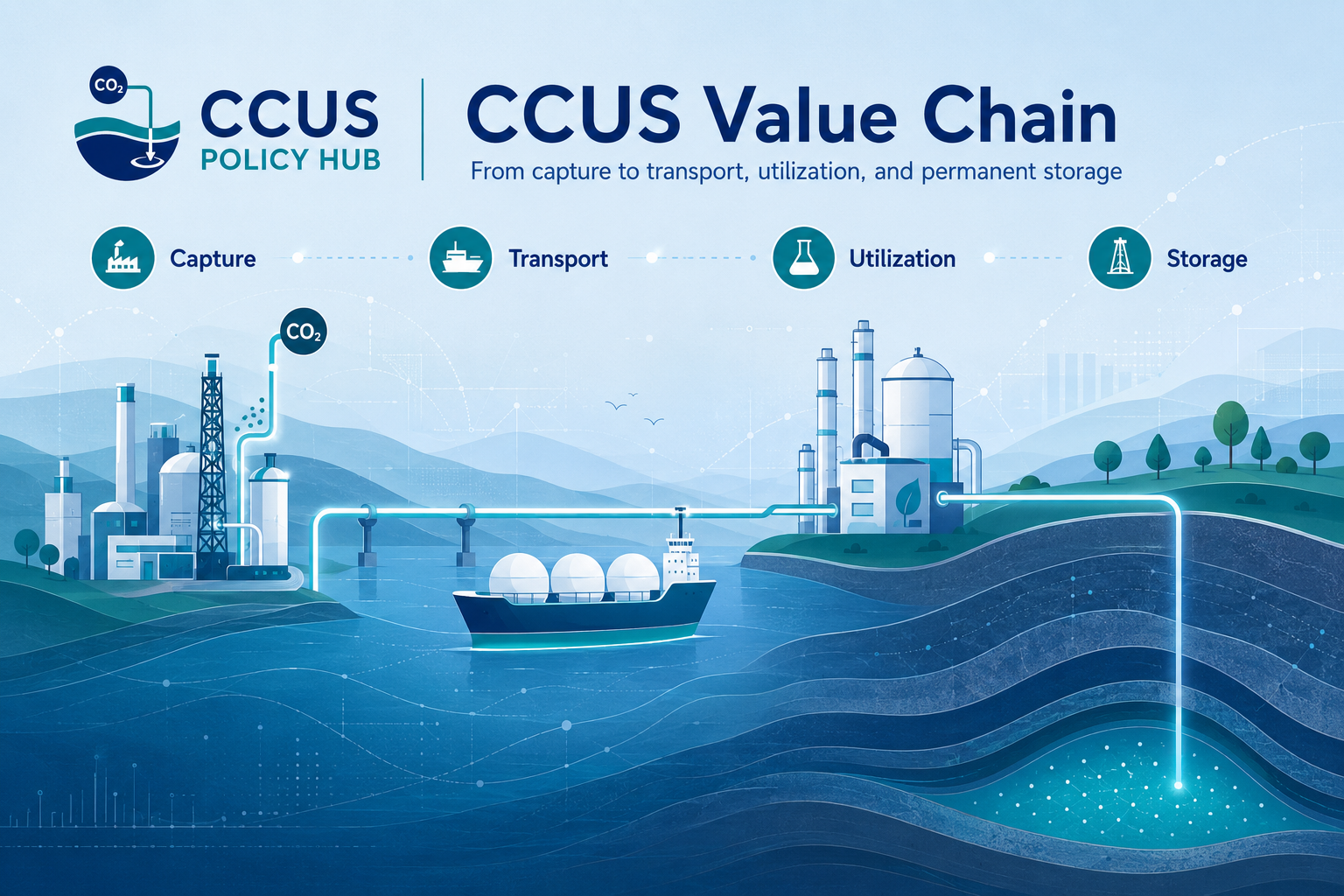
CCUS is not a single technology. It is a carbon-management system connecting capture, transport, utilization, geological storage, infrastructure, finance, monitoring, reporting and verification (MRV), and the policy frameworks that enable deployment.
The information problem
CCUS projects are capital-intensive, infrastructure-dependent, and developed over long time horizons. A project may depend simultaneously on capture incentives, storage licensing, pore-space rights, transport access, cross-border arrangements, liability transfer, financial assurance, MRV rules, and carbon-market recognition.
The relevant information is usually fragmented across legislation, government strategies, regulatory guidance, project announcements, facility databases, and technical reports. Policy sources and facility records are also updated on different schedules and frequently use incompatible terminology.
CCUS Policy Hub was created to structure these layers without pretending that they are the same type of evidence.
What the platform connects
The platform brings together three analytical layers:
- Policy and regulation — incentives, legal frameworks, permitting, storage rights, liability, MRV, market mechanisms, and cross-border rules.
- Facility and project records — status, type, sector, region, recorded capacity, location precision, operators, partners, and key dates.
- Governance and deployment analytics — country capability profiles, regional pipelines, committed project-record capacity, and evidence-quality indicators.
The 2025 Global Status of CCS report and the Global CCS Institute’s 2025 policy, legal and regulatory review both show that stronger policy frameworks and project deployment are increasingly connected at the jurisdiction and market-system level. They are useful strategic sources for identifying developments that require primary-source verification.
Evidence boundaries
The platform distinguishes context from direct applicability:
- A policy and a facility located in the same country have a country-level contextual relationship.
- A sector match can support a stronger structured applicability hypothesis.
- Only an official permit, funding decision, project filing, contract, or other explicit source can establish a direct evidence relationship.
The current facility-policy relationship layer is predominantly country-level. It must not be interpreted as proof that every linked policy legally applies to, funds, permits, or caused a specific project.
Likewise, a facility record is not always equivalent to one unique real-world project. Capture, transport, storage, and full-chain components may be recorded separately. Aggregated project-record capacity is therefore an analytical indicator, not net deliverable capture capacity or net geological storage capacity.
Source hierarchy
For record-level conclusions, the preferred source order is:
- legislation, regulations, government gazettes, regulator decisions, permits, and official programme documents;
- official government, regulator, multilateral, or project-operator publications;
- recognised research institutes and structured industry databases;
- reputable secondary reporting used only as a discovery lead.
Secondary articles can reveal missing developments, but they are not used as the final authority when an official or primary source is available.
Mission
CCUS Policy Hub aims to provide a structured, bilingual, auditable foundation for researchers, policymakers, project developers, market analysts, investors, and AI agents. Its purpose is to make evidence easier to find and compare while keeping uncertainty, source quality, geographic precision, and relationship confidence visible.
Core capabilities
- Policy access and comparison — compare incentives, regulatory pillars, legal weight, status, evidence, and sources across jurisdictions.
- Facility intelligence — explore facility records by geography, status, sector, type, capacity, and coordinate precision.
- Governance–deployment analysis — examine institutional capability alongside committed project-record deployment scale.
- Trust and AI-readable data — use governed SQLite data, bilingual exports, quality metrics, JSON endpoints, schemas, and AI documentation.